Head Table Seating Order: Who Sits Where (and Why)
The traditional head table seats the couple in the centre with the bridal party fanning outward — but the modern question is what to do with the spouses.
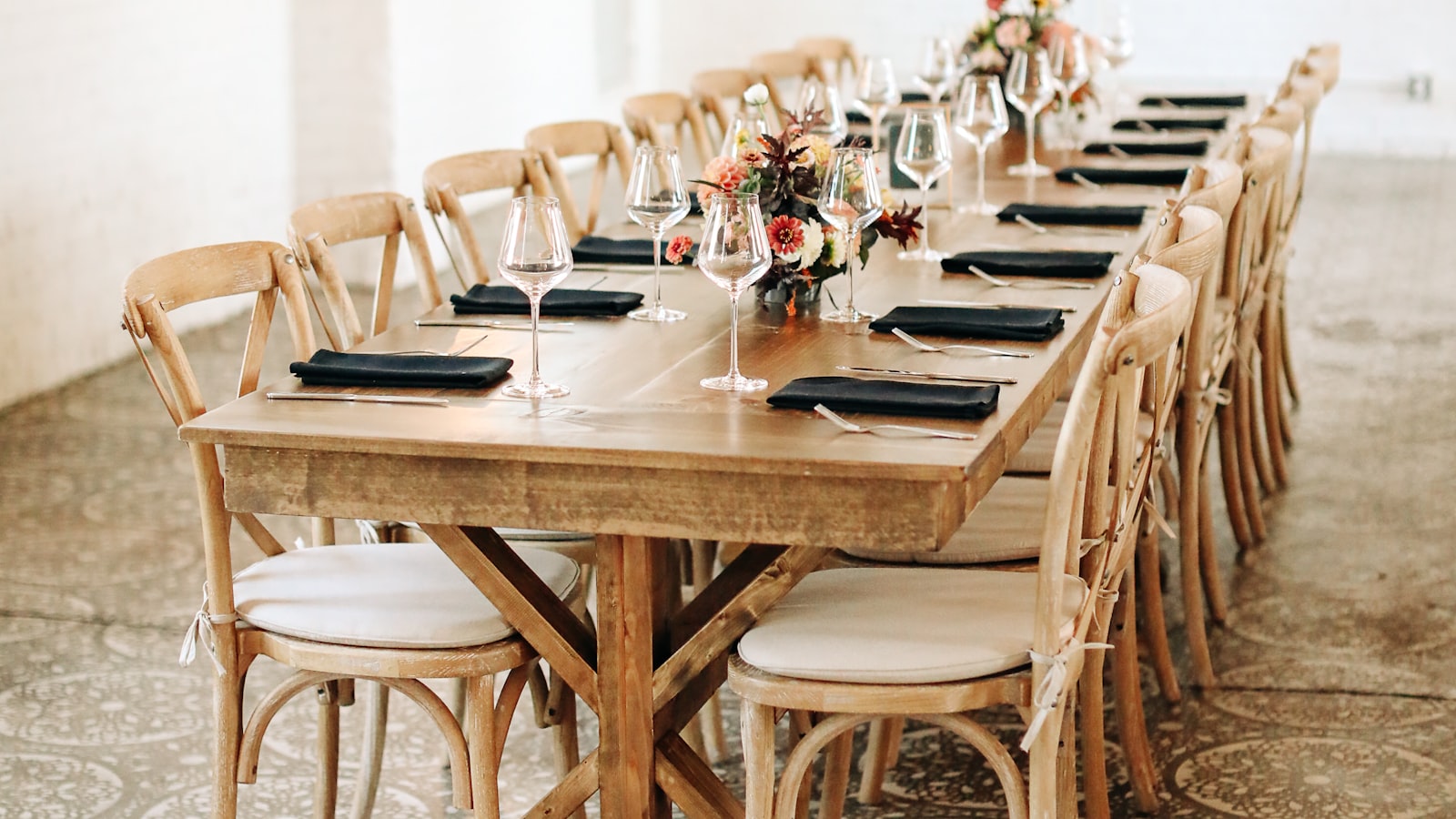
The traditional US head table puts the couple in the centre with the wedding party fanning outward, alternating bridesmaids and groomsmen. The bride sits at the groom's right — so from the audience, she's on the left and he's on the right. The maid of honour sits on the groom's other side; the best man sits on the bride's other side. Parents traditionally don't sit at the head table; they host a table of honour nearby.
That's the etiquette. The modern question is what to do with the wedding party's spouses, because every modern couple discovers within five minutes of seating-chart planning that the rules were written for a generation that wasn't married yet.
The traditional order, position by position
Picture the head table from the audience's perspective — the room is facing it during toasts, and that's the angle that matters.
Centre. The couple sits side by side at the middle of the table. In the traditional US arrangement, the bride is on the left (the groom's right) and the groom is on the right (the bride's left). This mirrors how couples traditionally stand at the altar. Plenty of modern couples flip this — to match a Mr & Mrs sign, to favour the photographer's preferred angle, or simply because of personal preference. The convention exists; it's not load-bearing.
Inside the couple. The maid of honour sits next to the groom. The best man sits next to the bride. The "honour attendant next to the opposite-gender member of the couple" pattern survives even as the rest of the etiquette has loosened.
Outward from there. The remaining bridesmaids and groomsmen fan outward, traditionally alternating. So from the audience: groomsman, bridesmaid, groomsman on the bride's side; bridesmaid, groomsman, bridesmaid on the groom's side. Some couples instead pair up by processional partners — whoever walked down the aisle together sits together — which is just as conventional and often easier socially.
Same-sex couples. No conventional rule applies; the couple picks who sits where. Wedding parties for same-sex couples often skip the alternating-gender pattern entirely and group by who-knows-whom.
Mixed-gender wedding parties. When a bride has a man of honour or a groom has a best woman, the etiquette accommodates them in the honour-attendant slot regardless of gender. The alternating pattern is decorative; the honour-attendant placement is structural.
What the UK does differently
Worth knowing if your families have UK roots. The UK top table includes parents — bride and groom in the centre, parents flanking, then the chief bridesmaid and best man on the outside. The US separates parents to a table of honour; the UK puts them at the top of the room with the couple. Neither is more correct; they're regional traditions.
If you're hosting a US wedding with UK guests (or vice versa), neither side will think the other arrangement is wrong. They'll just notice it.
Four configurations and which one fits
The traditional straight head table is one option of four, and most modern weddings end up at one of the other three.
| Configuration | What it is | Typical capacity | Best for |
|---|---|---|---|
| Traditional straight | One long rectangle, couple plus wedding party seated on one side facing the room | Up to 12 attendants | Couples wanting toasts to face the room and clean photos |
| U-shape | Long centre with extensions on each end | Up to 16 attendants | Larger wedding parties wanting everyone visible to the couple |
| King's table | Long rectangle seated on both sides, couple in the centre | Up to 26 (with dates) | Couples whose wedding party is mostly partnered |
| Sweetheart with flanking | Small round 4-foot table for the couple, with long tables on either side for wedding party | 12 wedding party + dates | Couples who want a private moment plus inclusive plus-ones |
| Sweetheart alone | Small round 4-foot table for the couple, wedding party at regular guest tables | Two | Couples who want intimacy and don't mind the visual |
The dimensions for each (sourced from venue coordinators):
- Straight head table: 24 feet long by 2.5 feet wide, made of three 8-foot banquet tables end to end. Seats up to 12 with about 24 inches per place setting.
- U-shape: 20-foot main section plus two 6-foot extensions. Seats up to 16 comfortably.
- King's table: 24 feet long by 5 feet wide, made of six 8-foot banquet tables in a 2x3 grid. Seats up to 26 with both sides occupied.
- Sweetheart with flanking: 4-foot round for the couple, plus two 12-foot tables (two 6-foot banquets each) on either side. Wedding party sits on the side facing the couple.
The plus-one problem (the real question)
Almost every modern couple lands on the same friction: the wedding party is mostly partnered, the head table doesn't fit everyone's spouse, and dinner becomes the most awkward forty-five minutes of the reception.
The failure mode is predictable. Couples plan a traditional head table, seat plus-ones at a "wedding party plus-ones" island somewhere else, and within fifteen minutes of dinner ending, the bridal party gets up from the head table to find their dates. The head table sits empty for the rest of the evening. Toasts happen with half the seats vacated.
Three fixes, in order of how often they work:
1. King's table. If venue space allows, this is the configuration that solves the problem cleanly. Long table, both sides seated, couple in the middle, wedding party plus their dates fanning outward. Everyone is at the table the couple is at, nobody is separated from their partner, and the visual is striking. The drawbacks are venue size — a 24-foot by 5-foot footprint takes up a lot of floor — and that the couple is surrounded rather than visible. Photographs are harder; conversation is better.
2. Sweetheart with flanking. A small round for the couple, with long tables on each side seating wedding party and their dates. The couple gets a private moment to eat together; the wedding party stays close; nobody is separated from their plus-one. The visual is more elegant than a king's table because the eye lands on the couple at the centre of the room. The trade-off is that wedding party members face the couple, not each other, which limits cross-table conversation.
3. Wider head table including spouses. Add the spouses to the traditional straight head table. Works if the wedding party is small (3-4 each side, plus partners, fits a 24-foot table). Doesn't work above about 14 total because place settings overlap. The arrangement looks the most like a "traditional" head table, which matters to some couples.
The arrangement that almost never works: a traditional head table that excludes spouses, with a separate "plus-ones" table somewhere else. The plus-ones don't know each other, the bridal party leaves the head table to find their partners, and the couple has dinner alone at a row of empty chairs.
Where everyone else goes
The head table is one decision; the gravity around it is another.
Parents. At the table of honour — the closest table to the head table, ideally on the dance-floor side of the room. In the standard US arrangement, both sets of parents share this table along with the officiant and grandparents (or, if grandparents aren't there, with close family friends or aunts and uncles). The point of the table of honour is symmetry: parents are physically close to the couple even if they're not at the head table.
Divorced parents. Each parent typically hosts a separate equal-status table at equal proximity to the head table — same size, same flowers, same dance-floor access. We covered the full version of this in the divorced parents wedding seating guide; the head-table-adjacent piece is that neither table should feel like the demoted one.
Stepparents. Stepparents who functioned as parents to the couple sit at the table of honour with their spouse. Stepparents with a more peripheral relationship sit at a nearby family table.
Officiant. At the table of honour, unless the officiant is family or a close friend (in which case, anywhere). If the officiant is leaving before dinner or skipping the meal, brief the coordinator so the empty seat is removed before toasts — an empty chair at the table of honour reads as a slight, even when it isn't.
Grandparents. Table of honour if mobility and energy allow, otherwise a close family table where they can leave early without disrupting anyone.
Children of the wedding party. Kids over about age 9 can sit at the head table if there's a place setting for them. Younger kids usually go to a kids' table or stay with their parents at a family table — the head table is a long stretch of expected behaviour for a six-year-old.
Wedding party members from out of town. Their lodging matters more than their seating. If the bridesmaid flew in from London, she's at the head table or at a king's table; she didn't fly in to sit at table 14.
Five practical mistakes to avoid
Cramming. Twelve attendants on a 16-foot head table looks fine in the floor plan and feels fine empty. Once you put down chargers and full glassware, the place settings overlap and toasts get bumped. Plan 24 inches per setting, minimum.
The plus-ones island. A standalone table of "wedding party significant others" is a table where nobody knows each other and everyone wants to leave. Either include them at the head table, use a king's table, or seat them with people they'll genuinely connect with — friends of the wedding party they already know, family members of similar age.
Toasts that face the wrong direction. A traditional straight head table works because everyone seated at it faces the room. A king's table is more inclusive but means half the wedding party has their back to the audience during the speeches. If toasts matter, plan the configuration with toasts in mind, not the other way round.
Forgetting that head tables don't fit on every floor plan. A 24-foot straight head table needs a wall it can sit against, plus 8 feet of clear space in front for service, plus enough room behind for the photographer to get a frontal shot without standing on the dance floor. Check this before the layout is locked, not after.
Ignoring the photo angle. The head table is the most-photographed table of the night. Walk the room with the photographer or visualise it from the audience: where will toasts be shot from, what's behind the couple, does the lighting work? Most "we hated the head table photos" complaints trace back to a wall colour or background nobody thought about until the day.
A workflow for deciding the head table
For most couples the order of decisions is configuration → who sits there → exact positions. That order matters; flipping it almost always produces a head table you can't fit in the room.
Count the wedding party and decide on plus-ones
Tally bridesmaids, groomsmen, and any other attendants. Decide whether plus-ones come to the head table. This is the single decision that determines configuration — yes-to-plus-ones means king's table or sweetheart-with-flanking; no means a traditional straight or sweetheart alone.
Pick the configuration that fits the count and the venue
Match the count to the table sizes above. If the venue has dimension constraints (low ceiling beam, immovable column, narrow long wall), confirm the configuration physically fits before locking it.
Sketch it on the venue floor plan
Most venues provide a CAD floor plan of the room. Mark the head table at the right scale, mark the table of honour next to it, mark the dance floor. Confirm there's room for service aisles and a clear walking path from the head table to the rest of the room.
Assign positions using the alternating rule
Couple in the centre. Honour attendants flanking. Remaining wedding party fanning outward in alternating gender, or paired by processional partner. Adjust if anyone has a specific seating need (mobility, hearing, family politics).
Walk through it in person before the day
On the rehearsal walk-through, lay out the head table with chairs and place-setting markers. Sit in each seat. Confirm sight lines to the audience, distance to the toasts microphone, comfortable elbow room. This catches problems the floor plan can't show.
Once the configuration is chosen and the positions are sketched, dropping it into a digital seating plan keeps everything synced. The SimplifyTables seating planner takes a venue floor plan as an image, lets you place the head table and table of honour where they actually go, and assigns names to seats. When the inevitable last-minute change happens — a parent can't make it, a plus-one cancels, the photographer wants the head table moved a foot to the left — you update once and the assignments stay aligned.
Plan your head table free for events up to 30 guests — no credit card.
A note on toasts and photographs
The head table is the most-photographed table of the night and the table from which most toasts happen. Two things that tend to go wrong:
Toasts. Have a microphone stand ready at one end of the head table or at the front of the dance floor. Toasts that happen seated, leaning across centerpieces, sound bad and look worse. Brief whoever's giving a toast on where to stand.
Photographs. The shot the couple usually wants — head table with all faces visible — requires a clear sight line from about 12 feet in front of the table. If a column, a chandelier base, or a service station blocks that line, move the configuration before locking it.
The closing thought
The head table is more theatrical than functional. Nobody at the head table eats more comfortably than they would at a regular table. Conversation is more limited, photographs are more posed, the mics are louder, the place settings are more visible. The reason the head table persists is that it gives the couple a stage for one specific hour of the day — toasts, plate-clinking, the moment everyone in the room turns and looks.
If that hour matters to you, the configuration is worth thinking through carefully. If it doesn't, the etiquette gracefully accommodates skipping the head table altogether: sit with your wedding party, sit with your families, sit at a regular table. The wedding tradition that's most often broken is the one that says you have to sit on a stage at all.
Frequently asked
Who sits at the head table at a wedding?
Traditionally, the couple sits in the centre with the wedding party fanning outward in alternating order — maid of honour next to the groom, best man next to the bride, then bridesmaids and groomsmen alternating. Parents do not traditionally sit at the head table in the US (they host a separate table of honour); the UK tradition includes parents at the top table. Modern couples often add the wedding party's spouses, replace the head table with a sweetheart table, or use a king's table that fits everyone.
Which side does the bride sit on at the head table?
Tradition seats the bride at the groom's right — meaning, when the audience faces the head table, the bride is on the left and the groom is on the right. This mirrors how couples traditionally stand at the altar. In practice, plenty of couples flip the order to align with their Mr & Mrs signage or to put the groom on the side where their photographer wants the light. The rule is conventional, not load-bearing.
Should the wedding party plus-ones sit at the head table?
Traditionally, no — the head table was reserved for bridal party only and spouses sat with general guests. In practice, modern couples find that arrangement creates two problems: plus-ones stuck at a table where they know nobody, and bridal party members getting up from the head table to find their dates. The fix is one of three: include spouses at a wider head table, use a king's table that fits everyone, or use a sweetheart table with the wedding party seated at flanking tables with their dates.
Where do parents sit if not at the head table?
At the table of honour — the closest table to the head table, on the dance-floor side of the room. In the standard US arrangement, both sets of parents share the table of honour with the officiant and grandparents (or close family friends, if grandparents aren't present). When parents are divorced or family dynamics are difficult, each parent often hosts a separate equal-status table at equal proximity to the head table.
What's the difference between a head table, a sweetheart table, and a king's table?
A traditional head table is a long rectangle with the couple and wedding party seated on one side, all facing the room. A sweetheart table is a small round (typically 4-foot diameter) seating only the couple. A king's table is a long rectangle seating people on both sides — couple in the centre, wedding party and their dates fanning outward. The choice between them is mostly about whether plus-ones get included and whether the couple wants intimate or surrounded-by-everyone.
What if the wedding party is too big for one head table?
If you can't fit everyone comfortably with about 24 inches of place-setting width per person, switch configurations rather than cramming. Options: U-shape head table (fits up to 16), king's table (fits up to 26 with both sides seated), or sweetheart-plus-flanking (sweetheart table for the couple with two long tables on either side seating the wedding party and their dates). Above 12-14 attendants on a single straight head table, place settings start to overlap and toasts become awkward.
Where does the officiant sit at the reception?
Unless the officiant is family or a close friend, they sit at the table of honour with parents and grandparents. The officiant is being honoured for performing the ceremony, not for being part of the wedding party. If the officiant is leaving early or skipping dinner, brief your coordinator so the seat doesn't sit empty during toasts.
Ready to build your seating chart in minutes?
Drag and drop guests, share by QR code, switch between guest list and floor plan with one tap. Free for events up to 30 guests.
Get Started FreeKeep reading
Wedding Seating Chart Etiquette: Who Sits Where in 2026
Modern wedding seating etiquette without the rulebook. Where the couple sits, how to handle divorced parents, and the four mistakes that cause real drama.
Divorced Parents Wedding Seating: Where They Actually Sit
How to seat divorced parents at a wedding without starting a family fight — front-row arrangements, reception tables, and the new partner question.
Last-Minute Wedding Seating Changes: The Workflow That Holds Up
Almost every wedding loses 5–10% of its guest list in the final week. Here's the workflow that turns last-minute seating changes into a five-minute task.