60 vs 72 vs 48 Inch Round Tables: Which to Choose
Which round table size to actually choose — guest count, room size, cost, and the mixed-size strategy planners use to break the 60-vs-72 deadlock.
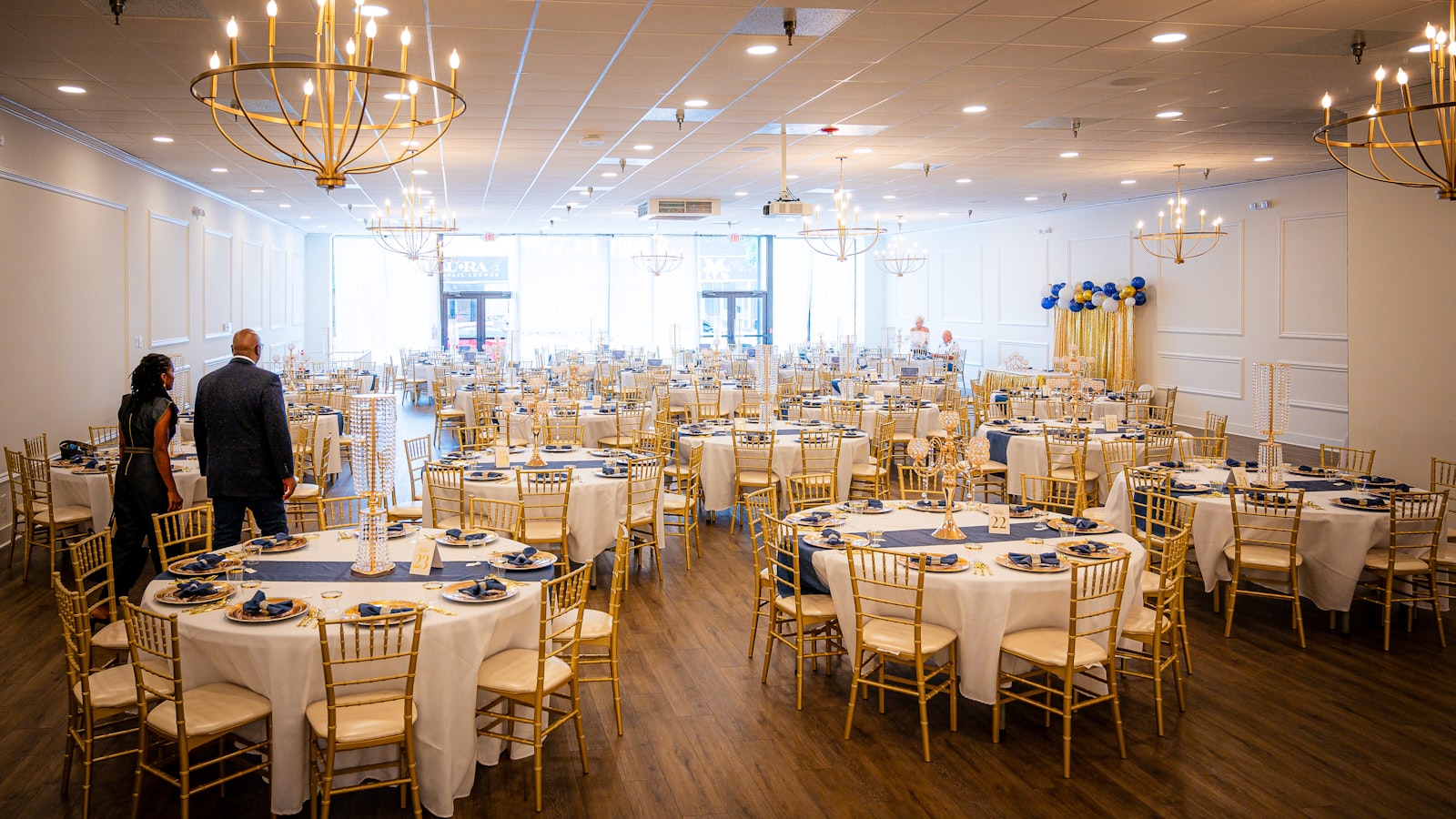
There's no single right size — but for most weddings, there's a default. Sixty-inch rounds win in roughly 80% of cases. Forty-eight-inch rounds are the right call for sweetheart tables, kids' tables, intimate weddings, and tight rooms. Seventy-two-inch rounds save real money on linens at large guest counts, but they make cross-table conversation harder in loud rooms.
One thing most articles skip: you're allowed to mix sizes, and a lot of experienced planners do. Below: when each size wins, when to mix, and the one thing your venue is probably overstating about capacity.
The quick decision
| Your situation | Pick |
|---|---|
| Most weddings, most rooms, most budgets | 60-inch |
| Sweetheart table for the couple | 48-inch |
| Intimate wedding under 60 guests | 48-inch + 60-inch mix |
| Kids' table, low chargers, smaller place settings | 48-inch |
| 250+ guests with floor space to spare | 72-inch (cost play) |
| Mixed friend-group sizes (4–6 here, 9–11 there) | 60-inch + 72-inch mix |
| Family-style or shared-platter menu | 72-inch |
| Loud venue, dance-heavy reception | Avoid 72-inch for cross-table talk |
If you fall into the first row — and most weddings do — stop reading and go with sixty.
When 60-inch is the right default
Sixty-inch rounds are the most common rental in the country, and that's not coincidence. They balance comfort and density: eight is genuinely comfortable, ten is the standard most venues quote, and the table fits the typical chair-width math without forcing guests into elbow-to-elbow contact.
The capacity math is covered in detail in our 60-inch round table guide — chair width, place setting depth, service style, the variables that change the answer. The short version: plan for ten with banquet chairs and a buffet, plan for eight with chiavari chairs and a plated dinner.
The reason 60-inch dominates isn't just capacity. It's that conversation actually works at this size. At a five-foot table, you can hear the person directly across without raising your voice. At six feet, that gets noticeably harder once the music starts. At four feet, you're so close together that the table can feel like a shared work surface rather than a dining table.
When 72-inch actually wins
Seventy-two-inch rounds make sense for one reason most of the time: cost at scale. With 360 guests, 60-inch rounds give you 45 tables; 72-inch rounds give you 36. That's nine fewer linens, nine fewer centerpieces, nine fewer numbered signs, and meaningfully less setup time on the day. At rental prices, the table difference itself is small (roughly $3 more per table for 72-inch). The savings stack up in linen and floral.
The trade-off is real: at 72 inches, the diameter is six feet. Conversation across the table is genuinely harder, and in a loud reception, you're effectively running two parallel three-person conversations on either side of the centerpiece. Round tables for ten in a loud room mean guests really only talk to the people beside them. That's not a 60-inch problem; it's a 72-inch problem.
When 72-inch wins:
- 250+ guest weddings where linen and centerpiece savings cover the conversation cost.
- Family-style menus that need centre-of-table real estate for shared platters.
- Multi-generational tables of nine to eleven that don't split into smaller groups.
- Large open rooms where setup speed and floor flow matter.
When 72-inch loses:
- Loud receptions with live bands or DJs near the dance floor.
- Plated formal dinners where the table is filling fast with chargers, glassware, and place cards.
- Smaller weddings where you'd only need three or four of them anyway.
When 48-inch makes sense (and it's not just kids)
Most articles dismiss 48-inch rounds as kids' tables only. That's wrong. Forty-eight-inch rounds are also one of the best options for several specific situations.
A sweetheart table for just the couple should usually be a 48-inch round or a small rectangular two-top. Anything larger and the couple looks marooned across an empty surface. The 48-inch fits both place settings, two glasses each, and a small centerpiece without dwarfing the people.
An intimate wedding under 60 guests can use 48-inch rounds throughout, seating five at each. Five at a 48-inch is genuinely comfortable, and the smaller tables make a 50-guest reception feel cosy rather than stretched-thin in a too-big room.
A kids' table at six guests works fine at a 48-inch — though if you're seating older kids who'll have full place settings, plan for five and add a chair if needed.
A tight room sometimes mathematically can't fit 60-inch rounds with adequate chair pull-out space. In that case, fewer 48-inch rounds at smaller capacity beats forcing guests into a 60-inch they can't pull a chair out from.
The mixed-size move most articles miss
This is the move that experienced planners use and almost no published article mentions: rent a mix of sizes for the same reception.
The technique: a combination of 60-inch and 72-inch rounds, with nine to eleven at the larger tables and six to eight at the smaller. The seating chart suddenly works because you're no longer trying to fit every cluster into a single capacity number.
The reason is simple. Friend groups don't come in sizes of eight. You'll have a college cluster of six, a coworker group of eleven, a bride's-side family group of fourteen, a groom's-side family group of seven. Forcing all of those into tables of eight or all into tables of ten creates awkward fillers and weird splits. A mix of sizes lets each cluster sit at the right table for its actual size.
The cost math (with real numbers)
Rental pricing varies by region but the typical bands are:
| Item | 60-inch round | 72-inch round | 48-inch round |
|---|---|---|---|
| Table rental | $10–$14 | $12.50–$15.25 | $9–$12 |
| Floor-length linen (90", 108", 78") | $15–$25 | $25–$40 | $12–$20 |
| Total per table (with linen) | $25–$39 | $37.50–$55.25 | $21–$32 |
For a 200-guest wedding, that's:
- 25 tables of 60-inch with linens: $625–$975
- 20 tables of 72-inch with linens: $750–$1,105
- The 72-inch option is slightly more expensive per table, but you also save on five centerpieces (typically $40–$120 each), which can swing the total $200–$600 in favour of 72-inch.
For a 350-guest wedding, the centerpiece-and-linen savings on 72-inch start to actually matter. Below 200, the savings rarely justify the conversation-flow trade-off.
One thing your venue is probably wrong about
Almost every venue and rental company quotes 60-inch rounds at ten guests. Almost every wedding planner who's actually tested it pushes back to eight or nine.
The pattern is consistent. Venues quote ten per 60-inch. Once chairs and full place settings are actually laid out — chargers, glassware, flatware, napkins — ten looks crowded enough that guests notice. By the time you can see it in person, it's usually too late to change the order.
When mixed sizes make the seating chart harder
Mixing table sizes solves the cluster-fit problem but creates a new one: your seating chart now has tables of different capacities to track. A spreadsheet that worked for "twenty tables of eight" gets messier when half the tables are nines and a quarter are elevens.
Drag-and-drop handles the irregularity. You can move a guest from a 72-inch ten-seat to a 60-inch eight-seat without re-numbering the rest of the room — and you can see at a glance which tables have one seat left and which are full.
Build a mixed-size seating chart with drag-and-drop — free for events up to 30 guests.
The bottom line
- Default to 60-inch. It's the best balance for most weddings.
- Use 48-inch for sweetheart tables, kids' tables, intimate sub-60-guest weddings, and tight rooms.
- Use 72-inch for 250+ guest weddings, family-style menus, and large open rooms — accept the cross-table conversation cost.
- Mix sizes when your friend-group sizes don't match a single table number. Aesthetic consistency lives in the linens and centerpieces, not the diameter.
- Don't trust the venue's capacity quote without mocking it up first. Real-world ten-per-sixty often looks like crowded eight.
Once you've picked your size, the next question is who sits at which table — which is where wedding seating gets political. The seating chart etiquette guide covers that.
Frequently asked
What's the real difference between 60 and 72 inch round tables for a wedding?
A 60-inch round comfortably seats eight (ten max); a 72-inch round comfortably seats ten (twelve max). The 72-inch saves money on linens and centerpieces because you need fewer of them, but it makes cross-table conversation harder in loud rooms. The 60-inch is the default for most weddings, and for good reason.
Can you mix 60 and 72 inch round tables at the same wedding?
Yes — and a lot of experienced planners do. The combination handles uneven friend-group sizes much better than forcing every cluster into the same table size. A 72-inch round for the table of nine cousins, a 60-inch round for the table of eight college friends, and a 48-inch round for a kids table all in the same room reads as intentional, not mismatched, as long as the linens and centerpieces match.
When should I use a 48 inch round table?
48-inch rounds are right for sweetheart tables (just the couple), kids' tables, intimate weddings under about 60 guests, and rooms tight enough that a 60-inch doesn't fit cleanly. They seat five comfortably and six at a squeeze. The mistake is using them only as kids' tables — a 48-inch round is also one of the best options for a sweetheart table because anything bigger and the couple looks marooned.
How much does it cost to rent round tables for a wedding?
Rental pricing depends heavily on region, but typical ranges are $10–$14 per 60-inch round and $12.50–$15.25 per 72-inch round. The bigger cost lever is linens — a 90-inch round linen (covers a 60-inch table to the floor) typically runs $15–$25, and a 108-inch round (covers a 72-inch table) runs $25–$40. At 250+ guests, the math starts favouring 72-inch rounds because of fewer linens and centerpieces.
Ready to build your seating chart in minutes?
Drag and drop guests, share by QR code, switch between guest list and floor plan with one tap. Free for events up to 30 guests.
Get Started FreeKeep reading
Wedding Seating Chart Etiquette: Who Sits Where in 2026
Modern wedding seating etiquette without the rulebook. Where the couple sits, how to handle divorced parents, and the four mistakes that cause real drama.
Head Table Seating Order: Who Sits Where (and Why)
The traditional head table seats the couple in the centre with the bridal party fanning outward — but the modern question is what to do with the spouses.
Last-Minute Wedding Seating Changes: The Workflow That Holds Up
Almost every wedding loses 5–10% of its guest list in the final week. Here's the workflow that turns last-minute seating changes into a five-minute task.